PRACTICAL TOOLS FOR STUDENT-LED PROJECTS
The Student
Ownership Kit.
Give students a clear purpose, meaningful decisions, and a useful way to work together. Choose the pages that fit the project you are already planning.
- Printable PDF
- Five-part process
- High-school projects
Inside the collection
- A quick start for choosing and using the pages
- Nine working pages, from project brief to team handoff
- Two fictional worked examples showing the process
Payhip has the current price, included files, and offer details. The PDF is designed to print and write on; it is not an interactive form.
Preview the free sample
2 working pages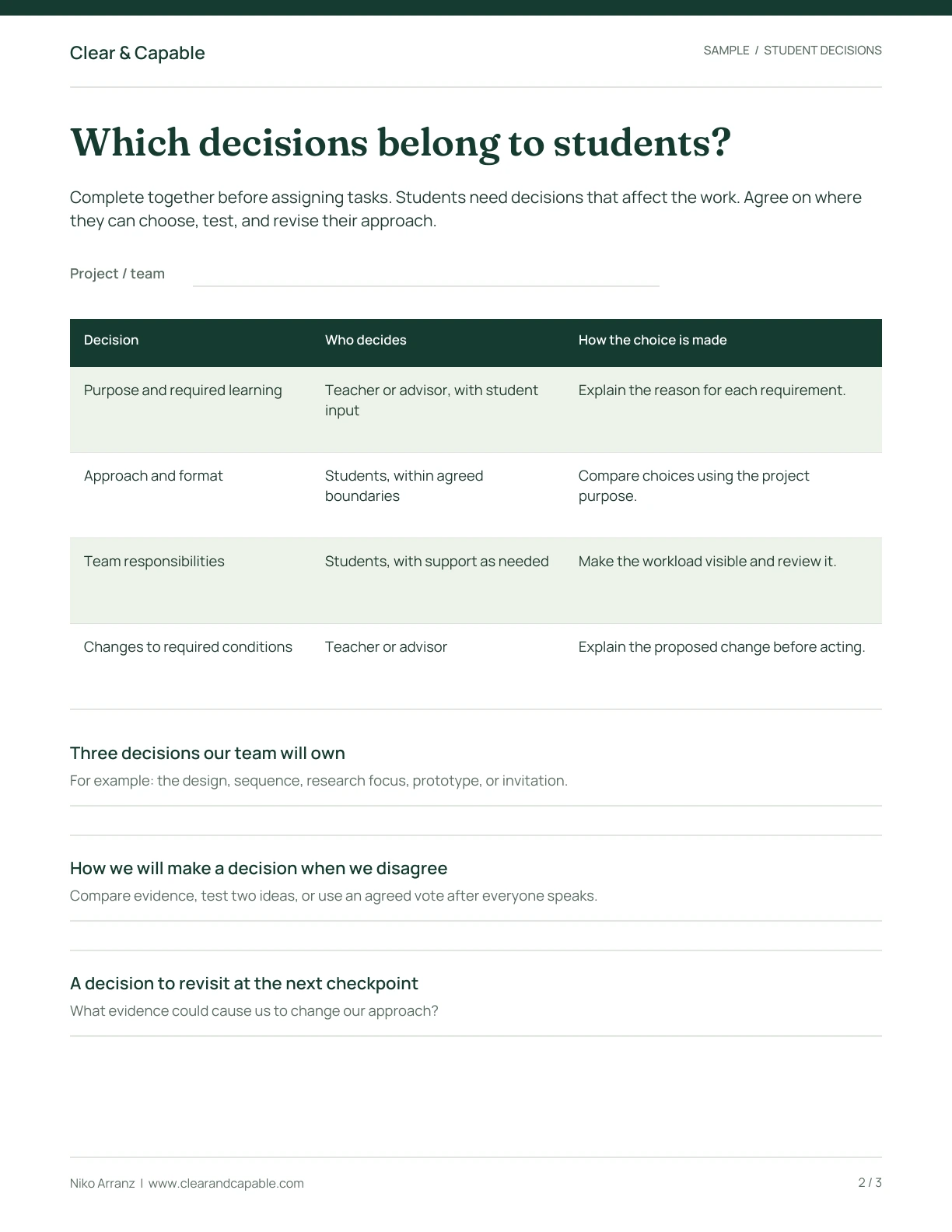
Student decisions · Agree on the boundaries, then make room for meaningful choices.
Read the page descriptions
Student decisions: Identify the project, the fixed boundaries, and the decisions students can make. The page asks the team to explain how its choices fit the people the work is for.
Roles and contribution: Connect each role with a visible contribution. Use the page to discuss responsibilities while keeping every student involved in the thinking and the wider project.
The three-page sample contains selectable text. Open the sample PDF to read the original pages.
Actual pages from the free sample. Download all 3 pages.
A LOOK INSIDE
Five parts.
One usable process.
Open a section to see its purpose and a prompt you can try.
Begin with a project brief01Define the purpose+
Bring the audience, purpose, deliverable, and evidence of success onto a single page.
“What should someone be able to do because this project exists?”
Project brief and purpose prompts.
02Decide what students own+
Make the requirements and students’ choices visible before work begins.
“Which decision can the team make without asking the adult to decide for them?”
Decision boundaries and student choice planning.
03Make teamwork visible+
Connect each responsibility to a contribution the team can see and use.
“What will each person contribute, and how will the team know it is ready?”
Responsibility planning and team agreements.
04Use helpful checkpoints+
Pause while feedback can still change the work. Give teams a practical way to ask for help and get moving again.
“What have you tried, what did you learn, and what decision do you need help making?”
Checkpoint, help-request, and recovery prompts.
05Finish and pass it on+
Check the work against its purpose, reflect on contributions, and leave instructions another person can use.
“What does the next person need in order to use what you made?”
Completion, reflection, feedback, and handoff prompts.
A FEW PRACTICAL DETAILS
Before you
begin.
Try one project first.
- Write the purpose and useful output.
- Choose the pages the team needs now.
- Return to them at a checkpoint and handoff.
Who is the kit for?+
High-school teachers and club advisors working with student teams. Choose expectations that fit your subject, setting, and the support your students need.
What can I try before buying?+
The free Project Clarity Builder helps you make a project brief on screen. The three-page starter gives you a printable beginning. The kit sample includes student decisions and roles-and-contribution pages.
Can I type into the PDFs?+
These are print-and-write pages, not interactive form PDFs. Use the free builder when you want to type a project brief and copy, download, or print your own responses.
How do I see the price and purchase details?+
The Payhip product page shows the current price, included files, and purchase options. Follow View the kit on Payhip above to see that offer.
Does this include coaching or a subscription?+
The kit is a downloadable resource collection. Personal coaching, custom project design, and an ongoing subscription are not included.
Are the worked examples real student results?+
The club welcome session and business information guide are original fictional examples. They demonstrate how a team might use the process; they are not testimonials or reports of measured outcomes.
YOUR NEXT USEFUL STEP
Start with the idea
you already have.
Bring a project you are planning. Make its purpose, student decisions, and next checkpoint clear.
Make a free project briefNo account. Your ideas, organized.